

Updated on October 28, 2026
Medically reviewed by Dr. Adrián Eduardo Cuenca Bravo. Last reviewed October 28, 2026.
In short: Growth hormone helps children grow taller only when there is a recognized reason for the short stature: growth hormone deficiency, Turner syndrome, being born small for gestational age without catch-up, Prader-Willi syndrome, chronic kidney disease, SHOX deficiency, Noonan syndrome, or severe idiopathic short stature. A pediatric endocrinologist confirms the diagnosis first with growth charts, bone age and blood tests. Treatment is daily injections for years, and the average extra adult height in idiopathic short stature is modest.
Key facts

The cause of short stature in kids usually revolves around heredity, structural problems like tumors, functional issues with the release of human growth hormone in the pituitary gland, injuries or a condition known as idiopathic short stature (ISS).
In the case of ISS, there is nothing physically wrong with the child. They just end up not growing to the normal range and are usually two standard deviations below average. In this case, and the beforementioned ones, growth hormone for short stature can be used as a viable treatment option.
Yes, for the conditions it is approved for. Children with growth hormone deficiency respond best, often with a strong catch-up in the first year. Children with Turner syndrome, SGA, Prader-Willi syndrome and severe idiopathic short stature also grow faster on treatment, though the final gain is smaller. It does not work for short stature caused by conditions that are not growth hormone responsive, and it does not add height once the growth plates have closed.

The gland known as the pituitary gland, which sits at the base of the brain in the middle of the head, carries with it a lot of responsibility. Actually, it’s not necessarily a lot of responsibility. But it’s a big, main job that it has to do on a daily basis.
That primary job is to release growth hormone into the bloodstream, which in turn, promotes the growing process. And not just with height, but with organs and all the connective tissue in the body.

Another fact you should be aware of is, children commonly go through a major growth spurt from the age of 4 to late teens. To be more specific, boys tend to grow all the way until they are around 20 and girls tend to stop at 17 years of age.
If the pituitary gland is misfiring during this process, and short stature in kids of either gender is noticed, HGH for height can be utilized.
To bottom line all of this, statistics show time and time again that short stature kids and growth hormones work in concert to promote height increases. And over a term of 5-plus years, it is not uncommon for children to gain 3 inches of height or more.
When height is below the 3rd percentile, when the child has crossed downward across two major percentile lines, when growth velocity is below the 25th percentile for age, or when height is far below what the parents’ heights predict. A child who is short but growing at a normal rate along a steady percentile usually has familial short stature or constitutional delay and needs follow-up, not treatment.
Idiopathic short stature (ISS) is height below -2 SD with no identifiable cause after a full evaluation: normal growth hormone testing, normal nutrition, no chronic disease or syndrome. The 2008 international consensus and the 2016 Pediatric Endocrine Society guideline allow growth hormone for ISS when height is below about -2.25 SD and the predicted adult height is well below normal, after discussing the modest expected gain with the family. Details: idiopathic short stature.

That being said, if it is your child who is taking HGH for short stature, that’s a different story altogether. Again, you should follow the prescribed dosage and timing of each treatment, which is often spread out in 6 or 7 doses during the week.
The actual amount varies, depending on the weight of the child. Obviously, those kids who are heavier are going to be prescribed a higher amount than skinnier kids.
It depends on the cause. Growth hormone deficiency, which can cause proportionate dwarfism, responds well. Skeletal dysplasias such as achondroplasia are caused by bone growth problems, not hormone shortage, and growth hormone produces little benefit; other treatments are studied for those conditions. The distinction is made by a pediatric endocrinologist and, when needed, a geneticist.

With growth records showing slow velocity, a bone age X-ray that is delayed, low IGF-1 and IGFBP-3 for age, and growth hormone stimulation testing. An MRI of the pituitary is done when deficiency is confirmed. The 2016 guideline stresses that testing is interpreted in context; one low lab value alone does not make the diagnosis. See HGH deficiency in children.

Any form of dwarfism starts at an early age. When it comes to reversing this condition, growth hormone dwarfism treatment is going to be the best option. However, you do need to realize that this must be done in childhood.
Once someone reaches the age in which they’re growth plates close, it no longer helps the situation. The underlying message is that growth hormone for short stature can actually work as long as it is utilized in younger children.
All that being said, adults who are dwarfs can still benefit on HGH for short stature but in a different way. Associated side effects of dwarfism like being overweight, hormonal imbalances and lower physical function can all be reversed by use of injections and other forms of HGH treatments.
By body weight and diagnosis, within the labeled range for the specific indication, and then adjusted against height velocity, IGF-1 and side effects at each visit. Doses are higher per kilogram for Turner syndrome, SGA and ISS than for classic deficiency. Parents do not adjust the dose between visits; the endocrinologist recalculates as the child grows.

In the right diagnosis, yes. The first-year growth velocity typically increases substantially, then settles. The earlier treatment starts before puberty, the more growth years remain. Once puberty is advanced and bone age is near maturity, little height can be added. See does HGH make you taller.

It varies by diagnosis. Children with growth hormone deficiency treated early often reach a near-normal adult height. In idiopathic short stature, controlled studies average about 3 to 7 cm of extra adult height after several years of daily injections, with wide individual variation. In Turner syndrome gains of around 5 to 8 cm are reported with early, consistent treatment. These are averages, not promises.

No. Guidelines are explicit that treatment is for defined indications. Using growth hormone in a healthy short child exposes them to daily injections, cost and monitoring for a small or absent benefit, and it is not approved for simply wanting to be taller. A proper evaluation protects the child from unnecessary treatment as much as it identifies those who need it.
As soon as a treatable diagnosis is confirmed, because growth years cannot be recovered. For SGA, guidelines suggest treatment can start from age 2 to 4 if catch-up has not occurred; for ISS and deficiency, as early as the diagnosis is made. Treatment continues until growth velocity falls to near zero or bone age shows the growth plates are closing.
Decades of registry data show growth hormone is generally safe at labeled doses in children with recognized indications. Side effects to watch for include headaches (rarely raised pressure in the head), hip or knee pain (slipped capital femoral epiphysis), worsening scoliosis and changes in blood sugar. Children with Prader-Willi syndrome need sleep and airway assessment before and during treatment. See growth hormone side effects.

Not to mention, this is the reason why a collection of lifestyle choices become so important. Weight-bearing exercise, for example, helps keep the legs, core, and back strong, which slows down the degradation process and helps maintain good posture.
Stretching key areas in the back can keep connective tissue strong, the spine supple and the joints in good working order. Avoiding smoking and large amounts of alcohol while following a healthy diet can further work advantageously to help you maintain optimal height as you get up in age.
Now, let’s shift gears to kids. As mentioned above, growth hormone for short stature is absolutely a good option to get children more in the normal range for their age. But be aware that results do vary.
Everyone reacts differently to different stimuli. You should be well aware of this before you have your kid go through a run of HGH for height increase. Additionally, it is never too early to get your child headed in a healthy direction with their lifestyle as well.

All of the rules that should be followed by adults can also be taken into consideration by adolescents. Take exercise for example. A healthy dose of daily movement and activity, and even more focused bodyweight strength training drills, can have a major impact on posture, weight maintenance, and overall happiness.
Educating kids on healthy eating will further keep their body girth in check and it can also contribute to healthy bones. And in the best of cases, consuming foods with high nutrient density can spark growth and keep your child headed in that direction.
Then, when using growth hormone therapy for short stature, you may notice that the results are more exponential.

All of the rules that should be followed by adults can also be taken into consideration by adolescents. Take exercise for example. A healthy dose of daily movement and activity, and even more focused bodyweight strength training drills, can have a major impact on posture, weight maintenance, and overall happiness.
Educating kids on healthy eating will further keep their body girth in check and it can also contribute to healthy bones. And in the best of cases, consuming foods with high nutrient density can spark growth and keep your child headed in that direction.
Then, when using growth hormone therapy for short stature, you may notice that the results are more exponential.
Short stature is common, and most short children are healthy. The decision to treat is medical, made by a pediatric endocrinologist after a structured evaluation, with realistic expectations about the gain. If the diagnosis is right and treatment starts early, growth hormone can change a child’s adult height; if the diagnosis is not there, it should not be used.
At HGH Vallarta, pediatric cases are evaluated by Dr. Adrián Eduardo Cuenca Bravo. The pathway is a consultation, growth records and labs, and a prescription only when a recognized indication is confirmed. See pediatric growth hormone therapy.

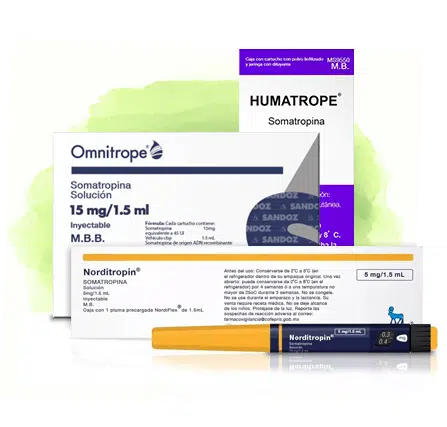
All approved brands contain the same recombinant somatropin and are equally effective at the same dose. The choice depends on the device the family finds easiest, cartridge sizes for the child’s dose, and availability. Daily pens include Norditropin, Omnitrope, Genotropin, Saizen and Humatrope; Ngenla is a once-weekly option for pediatric growth hormone deficiency.
Below the 3rd percentile for age and sex on a standard growth chart, which is about 2 standard deviations below average. Growth velocity matters as much as the percentile itself.
It depends on the diagnosis and age at start. Children with growth hormone deficiency treated early can reach a near-normal adult height; in idiopathic short stature the average gain is about 3 to 7 cm.
Usually until growth is nearly complete, which can be several years. Treatment is daily injections, with visits every 3 to 6 months to check growth, IGF-1 and side effects.
No. Treatment is restricted to defined diagnoses, and guidelines advise against it for children who are short but growing normally.
Sources